
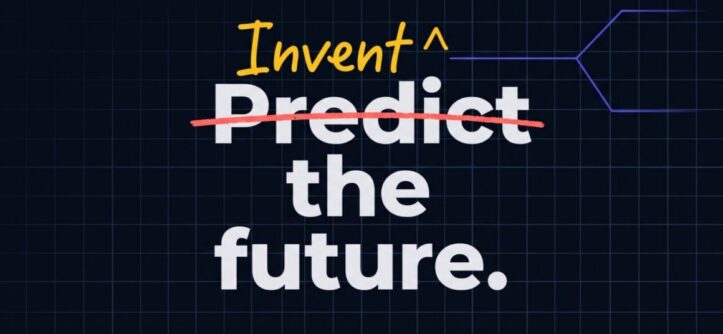
In 1971, at Xerox PARC, someone asked Alan Kay to forecast where computing was heading. His answer has outlived almost every forecast made that decade:
“The best way to predict the future is to invent it.”
He wasn’t being clever. He was describing how he and his colleagues worked. While others were writing reports about what computers might become, the PARC team was building it: the personal computer, the graphical interface, object-oriented programming, networked machines on every desk. The future everyone else was predicting arrived because a small group stopped predicting and started building.
Fifty-five years later, most organisations are back in prediction mode.
The forecasting trap
Look at how leadership teams are responding to AI. Commission a report. Run a pilot. Wait for the dust to settle. Benchmark against peers. Ask the consultants what the industry will look like in 2030.
All of it is forecasting. All of it treats the future as something that happens to the organisation, rather than something the organisation makes.
A few weeks ago I wrote about p(fab), the probability that we build something fabulous with AI. The point was simple: p(doom) gets estimated, p(fab) gets built. Alan Kay was making the same argument half a century earlier. You don’t find out what the future holds by studying it harder. You find out by shipping it.
Why this matters more now than it did in 1971
Kay’s team had to invent their own tools before they could invent the future. They built the machines, wrote the languages, designed the interfaces from scratch.
We don’t have that constraint.
We now have more powerful tools to invent the future than at any point in human history. A small team with the right agents can do work that once needed an entire department. A single workflow, rewritten from first principles, can collapse weeks of queues, handoffs and rework into hours. The cost of building has fallen through the floor.
This is what the Organizational Singularity describes: the point at which an organisation stops bolting AI onto the old structure and starts operating as an AI-native system, where intelligence runs through the work itself rather than sitting beside it.
Nobody forecasts their way to that point. You build your way there, one workflow at a time, at the Edge of the organisation where the old rules don’t yet apply and a small team can move without asking permission from the machine it is replacing.
The real question
Here is what strikes me about most of the AI conversation right now. It is almost entirely about the tools. Which model, which vendor, which benchmark, which agent framework. The tools are no longer the scarce resource. They are abundant, cheap and improving every month. What is scarce is intent. A clear purpose, a leadership team willing to build rather than wait, and the discipline to redesign the work instead of automating the mess.
Kay’s line puts the responsibility where it belongs. If the best way to predict the future is to invent it, then the future of your organisation is a design decision you are making right now, whether you make it deliberately or by default.
So the question isn’t what AI will do to your organisation. It is, What are we going to build with them?
Where do you actually stand? The REWRITE Score v2 is live
You can’t invent a future you can’t locate yourself against. That’s why we built the REWRITE Readiness Score, and why we’ve just rebuilt it.
Version 2 is a far more robust instrument:
- 24 questions across eight dimensions of AI-native readiness, replacing the original assessment
- Specific prescriptions for your two weakest dimensions, so you know where to start building rather than just where you scored
If you took the original version, this is the perfect opportunity to reset. The model underneath has changed enough that a fresh baseline is the only honest starting point, so please take it again.
It takes a few minutes. The insight it gives you is worth far more.
Then tell me in the comments: what’s the first thing you’re going to build?
By Salim Ismail, Co-Founder & Partner at Exponential Venture Capital | Founder OpenExO | Author of “Exponential Organizations”


Leave a Reply